
When Information Becomes Overload | MAHA Monday
A grounded way to quiet the noise, protect your attention, and choose what actually matters for your health.

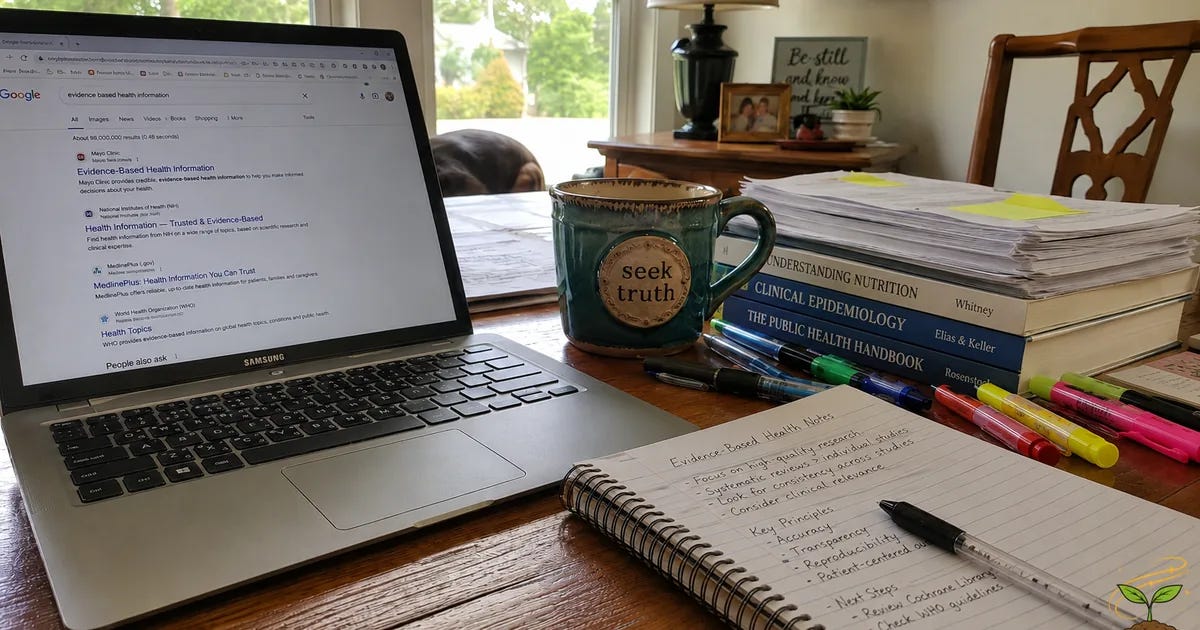
There is so much information coming at people now that it can make your head spin before you even know what question you were trying to answer. One person says one thing. Another person says the opposite. One headline tells you something is dangerous. Another tells you it is the miracle you have been waiting for. Then come the videos, the podcasts, the experts, the comments, the warnings, the testimonials, the supplement ads, and the dramatic claims that make everything feel urgent.
And before long, you are not more informed.
You are more tired.
I believe health information overload is one of the quieter ways people are being pulled away from their own common sense. It does not always look like confusion at first. Sometimes it looks like research. Sometimes it looks like responsibility. Sometimes it looks like trying to be a good steward of your body. But when the information never settles into wisdom, when it only creates panic, pressure, and second-guessing, something has gone wrong.
Because the goal is not to know everything.
The goal is to become clear enough to choose what actually matters.
Why Health Information Feels So Heavy Now
A person can open their phone before breakfast and be told what to eat, what not to eat, what toxin is hiding in the house, what lab test they need, what diagnosis they might have, what ingredient is ruining their hormones, what new study changes everything, and what product will finally fix them. That is too much for the nervous system to carry all day long.
I do not say that because information is bad. Information can be powerful. Good information can help a person ask better questions, notice patterns, protect their family, and stop accepting answers that do not make sense. I have always believed people deserve to be informed.
But information is only helpful when it leads to clarity, not when it leaves you frozen.
This is where I think we have to slow down.
Not every warning needs to become your emergency. Not every trend needs to become your protocol. Not every confident voice has earned your trust. And not every piece of information belongs in your life right now.
There is a difference between learning and absorbing noise.
Learning gives you a steadier place to stand. Noise makes you feel like the ground keeps moving under your feet.
More Information Does Not Always Mean Better Decisions
We have been trained to believe that if we just keep looking, we will eventually find the perfect answer. The perfect diet. The perfect supplement. The perfect expert. The perfect plan. The perfect explanation for every symptom, every craving, every ache, every low-energy day, every change in the body.
But sometimes the search itself becomes exhausting.
I cannot ignore how easily the Sickness Economy benefits from confused people. A confused person keeps clicking. A scared person keeps buying. An overwhelmed person keeps outsourcing their judgment because they are too worn down to sort through it all.
That does not mean every product is bad or every expert is wrong. It means we need to be honest about the environment we are living in.
Confusion is profitable.
When people are overwhelmed, they may stop asking the most important question: “What is actually true for my body?” They start asking, “What is everyone else saying I should do?”
Those are very different questions.
So much of real health comes back to the simple things we are tempted to overlook. Sleep. Food that looks like food. Hydration. Movement. Less stress where we can control it. Fewer chemicals where we can avoid them. A steadier rhythm. A little more trust in the body’s signals.
The basics are not weak just because they are not dramatic.
And I believe that is one reason they get ignored. The steady things do not always make exciting headlines. They do not always sell a product. They do not always give someone a viral moment. But the body still needs them.
Your body still needs rhythm.
Your body still needs nourishment.
Your body still needs rest.
Your body still needs room to recover.
How to Tell the Difference Between Guidance and Noise
One of the most important filters I believe we can build is the ability to pause before we absorb something. That pause matters. It gives you room to ask, “Who is saying this? Why are they saying it? What are they selling? Is this based on real evidence, or is it built on fear? Does this apply to me, or is it just another general claim being thrown at everyone?”
That one pause can protect you from a lot.
Useful guidance usually helps you think more clearly. It explains instead of manipulating. It gives context. It does not demand that you panic. It does not make you feel foolish for asking questions. It does not pretend that one answer fits every person in every situation. And it does not require you to abandon your own observation of your body.
Noise usually has a different feeling.
It rushes you.
It shames you.
It tells you that if you do not act right now, you are failing yourself or your family. It makes health feel like a test you are always losing. It throws a hundred problems at you without helping you take one grounded step.
I believe discernment is a health skill. It is not cynicism. It is not closing your mind. It is learning how to stay open without becoming gullible, and how to stay cautious without becoming afraid of everything.
Discernment lets you say, “This may be useful, but not for me right now.”
Discernment lets you say, “I need more context before I trust this.”
Discernment lets you say, “This person sounds confident, but confidence is not the same thing as truth.”
Discernment lets you stay awake without becoming frantic.
And that matters, because the goal is not to live afraid. The goal is to live aware.
Build a Personal Filter Before You Build Another Health Plan
Before adding another protocol, another supplement, another expert, or another list of things to worry about, it may help to build a simple personal filter. A filter is not about ignoring information. It is about deciding what gets access to your attention.
Start by asking whether the information is relevant to your real life right now. If you are exhausted, inflamed, stressed, and barely sleeping, you may not need a complicated stack of new ideas. You may need rhythm. You may need support. You may need to stop letting ten different voices rearrange your day before you have even checked in with your own body.
Then ask whether the information leads to a practical next step. If it only makes you feel scared, helpless, or behind, be careful with it. Good information should give you something useful to do, even if that action is simple.
Drink more water.
Eat a real breakfast.
Go outside.
Read labels.
Ask better questions at your appointment.
Keep a symptom journal.
Turn off the phone earlier.
Stop trying to fix everything by Friday.
Sometimes the discipline is not doing more. Sometimes the discipline is protecting your mind, your energy, and your nervous system from constant input.
Your attention is part of your health. Guard it like it matters, because it does.
I believe this is one of the most overlooked pieces of health sovereignty. We talk about food. We talk about toxins. We talk about medicine. We talk about farming. We talk about stress. All of that matters.
But what about the steady drip of fear, confusion, comparison, and urgency going into the mind every single day?
That matters too.
Your body is not separate from the information environment you live in. Constant alarm has a cost. Constant second-guessing has a cost. Constant scrolling through health warnings while your body is asking for rest has a cost.
A Simple Way to Filter What Deserves Your Attention
If you feel overwhelmed, try bringing the question back down to earth.
Ask yourself:
Does this help me understand my body better?
Does this give me one grounded next step?
Does this make me more capable, or more afraid?
Does this person explain clearly, or do they only stir panic?
Is this information urgent, or is it being made to feel urgent?
Do I need to act on this today, or can I let it sit?
Those questions can become a kind of shield. Not a wall that keeps everything out, but a filter that keeps everything from flooding in.
You do not need to absorb every headline.
You do not need to have an opinion on every new claim.
You do not need to change your life every time someone online sounds convincing.
And you do not need to carry the weight of every possible health concern at the same time.
A grounded person is much harder to manipulate than an overwhelmed one.
That is why slowing down matters. That is why common sense matters. That is why learning to filter matters.
Come Back to the Body in Front of You
If information overload has made you feel scattered, start smaller. Come back to the body in front of you. What is it telling you? Are you tired? Are you tense? Are you hungry but running on caffeine? Are you reacting to everything because you have not had a quiet moment all day? Are you trying to research your way out of a life rhythm that is wearing you down?
I believe we have to bring health back down to earth. Not because research does not matter. It does. Not because outside guidance does not matter. It can. But because your body is not an abstract project.
It is where you live.
So begin with one filter and one step.
Choose one or two trusted sources instead of twenty. Stop taking health advice from every dramatic post that crosses your screen. Notice whether a piece of information makes you clearer or more frantic. Give yourself permission to let some things wait. And before you add anything new, ask whether your foundation is being supported.
Are you sleeping?
Are you eating real food?
Are you moving?
Are you getting any daylight?
Are you making space to breathe?
Are you giving your body a chance to recover from the noise?
The world is not going to get quieter on its own. The headlines will keep coming. The influencers will keep talking. The ads will keep promising. The arguments will keep circling.
But you can decide what gets to live in your mind all day.
And that is not a small thing.
Filtering what matters is not about knowing less. It is about becoming steady enough to use what you know.
If this helped you feel a little less overwhelmed and a little more grounded, I invite you to share it with someone who is tired of being pulled in a hundred directions. And if you’re new here, welcome. Subscribe and walk with me through these MAHA Monday conversations as we keep coming back to health sovereignty, common sense, and the body’s God-given ability to heal when we stop working against it.
With love and truth,
—Donna 💚